Blog
What Is an AI Workforce? A Complete Guide for 2026
An AI workforce, defined

An AI workforce is a set of AI agents that work together like a team of employees — with roles, responsibilities, tools, and the ability to hand off work to each other. It is fundamentally different from a single chatbot or a one-shot AI assistant.
In a traditional AI setup, you prompt a model and it responds. In an AI workforce, a request enters through one agent (usually a coordinator), gets routed to the right specialist (research, writing, analysis, outreach), and the result flows back with context preserved across the whole team.
Think of it as the difference between hiring a freelancer and building an org.
Why 2026 is the tipping point for the AI workforce
The AI workforce concept is not new — the operational maturity is. Three shifts converged this year:
- Model reliability finally crossed the threshold where multi-step agent workflows complete without a human babysitter on every step.
- Enterprise capital committed at scale — Cognizant announced it will deploy 15,000 AI professionals under its Frontier initiative and hire 1,500 U.S. college graduates in 2026 to power the AI-era workforce.
- Cost per agent hour dropped ~80% year-over-year as inference prices collapsed, making it economical to run agents 24/7 across long tail tasks.
Cognizant's own research suggests AI could unlock $4.5 trillion in U.S. labor productivity — but only for organizations that treat AI as a workforce, not a feature.
AI workforce vs AI agents vs AI assistant — the difference
The terms get mixed up. Here is a clean split:
- AI assistant — one agent, one conversation, one turn at a time. Great for Q&A, poor at multi-step work.
- AI agent — one agent that can plan, use tools, and act autonomously over multiple steps. Great for a defined workflow.
- AI workforce — many agents, structured into a team, that collaborate across departments. Great when the work spans functions (sales AND finance AND legal review, for example).
You do not skip straight to a workforce. You start with one reliable agent, prove the pattern, then grow the team around it.
The five roles every AI workforce needs
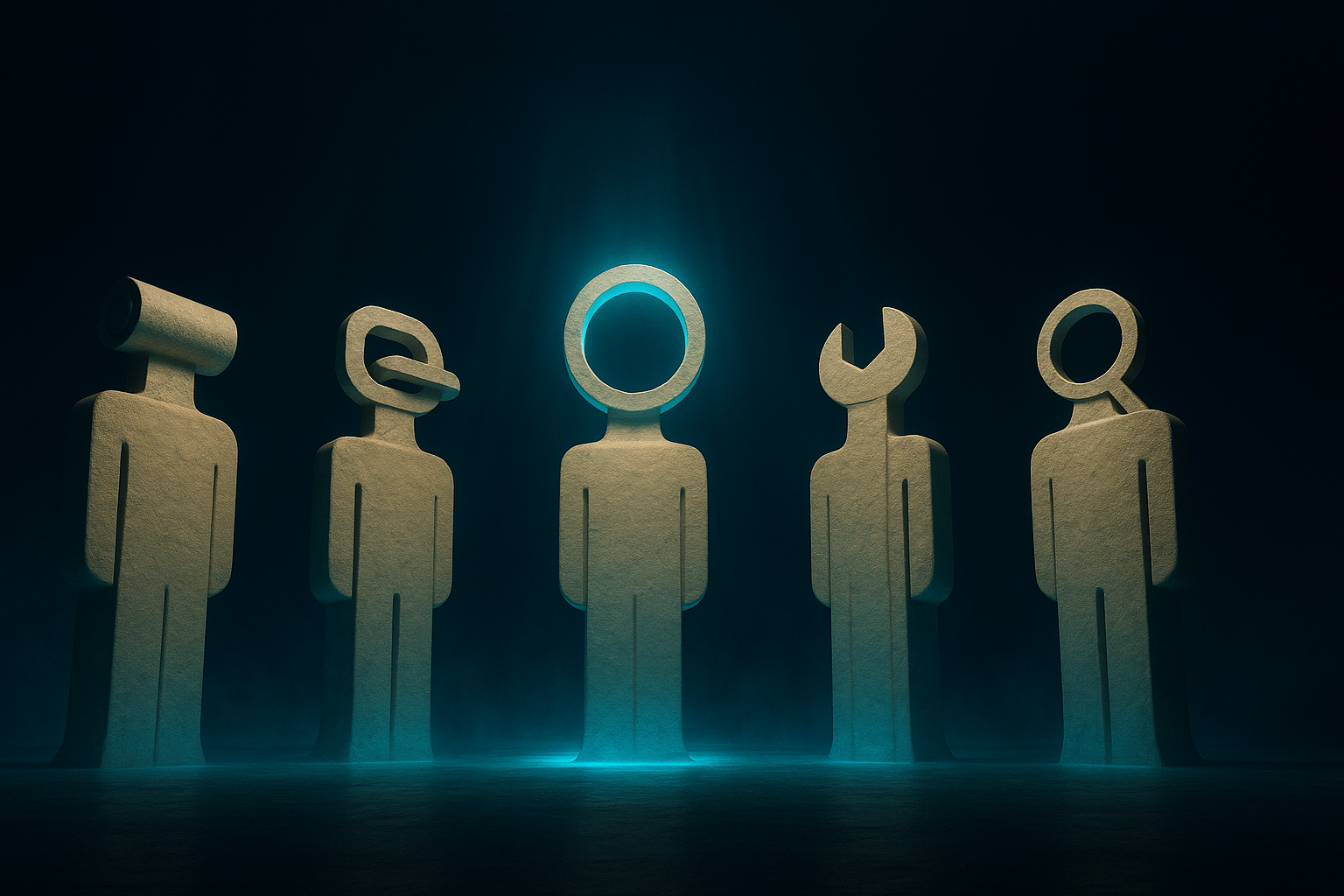
A working AI workforce — regardless of vertical — tends to converge on the same five archetypes:
- The coordinator — receives requests, decides who handles them, tracks the outcome. In MANAV this is your principal agent.
- The specialists — deep in one domain: a finance agent that reads your P&L, a legal agent that reviews contracts, a sales agent that qualifies leads.
- The critic / reviewer — checks the work of the specialists before it reaches a human. Catches hallucinations and off-brand output.
- The connector / integrator — moves data between systems (CRM, ERP, email, Slack, calendar) so agents can act, not just recommend.
- The historian — remembers what was decided, what the customer told you last month, what worked and what did not.
Miss any of the five and the workforce feels flaky. Get all five in place and it starts to feel like a real team.
How MANAV builds an AI workforce

On MANAV, an AI workforce is not something you code from scratch. You describe the roles you want, pick from a pre-built library of agents (finance, sales, HR, legal, procurement, marketing), and the platform wires them into a coordinated team with the guardrails already in place.
Under the hood, MANAV runs each agent through an orchestrator that handles context, tool access, skill matching, and safety checks — so you get workforce-level reliability without building the middleware yourself. As the World Economic Forum put it, "trust is the new currency in the AI agent economy" — which means the audit trail and human oversight matter as much as the agents themselves.
See our pricing for how many agents come with each plan, or read the FAQ for the operational questions we hear most often.
Frequently asked questions about the AI workforce
Is an AI workforce a replacement for human employees? No. In every deployment we have seen, the AI workforce handles the repetitive 20% that consumed 80% of a team's time — freeing humans for judgment work, customer relationships, and net-new ideas.
How many AI agents do I need to start? One. Start with one specialist for your most painful bottleneck. Only expand the workforce once that first agent is trusted.
What is the difference between an AI workforce and RPA? RPA follows fixed scripts. An AI workforce reasons about the goal, adapts to unexpected inputs, and uses natural language to hand off work.
Do I need my own LLM to run an AI workforce? No — but you can. See our post on Bring Your Own LLM (BYOLLM) for when it matters.
You may also like
AI Audit Trail: How to Audit Your AI Agents (2026 Compliance Guide)
An AI audit trail is the tamper-evident record of what your AI agent did, when, and why. With the EU AI Act's enforcement window opening August 2, 2026, and 88% of enterprises reporting AI agent security incidents in the last year, an audit-ready agent is no longer optional. Here's what the audit trail actually needs to capture, how to build one that survives an auditor's questions, and why retrofitted audit trails always cost more than the ones you build on day one.
AI Red Lines: What the UN Actually Asked For (and What Your Team Should Do)
On September 7, 2026, UN rights chief Volker Türk asked the world to agree on "AI red lines" — actions AI should never be permitted to take without a human. The signal in that statement is not "slow AI down." It is "decide which actions require a human, then enforce it." Here is what red lines mean, why they matter, and how your team draws them this week.
AI Agent Evaluation: The Framework Every Team Should Adopt in 2026
An AI agent evaluation framework is how you know your agent is any good — before you ship it, and while it runs in production. This guide covers the three-level eval stack (unit tests, LLM-as-judge, online evals), the metrics that actually matter for agents (versus one-shot LLMs), and how to design rubrics that stabilize at 85%+ human agreement in three iterations.