Blog
Agentic AI vs Generative AI: The Complete Difference (2026)
The one-line answer
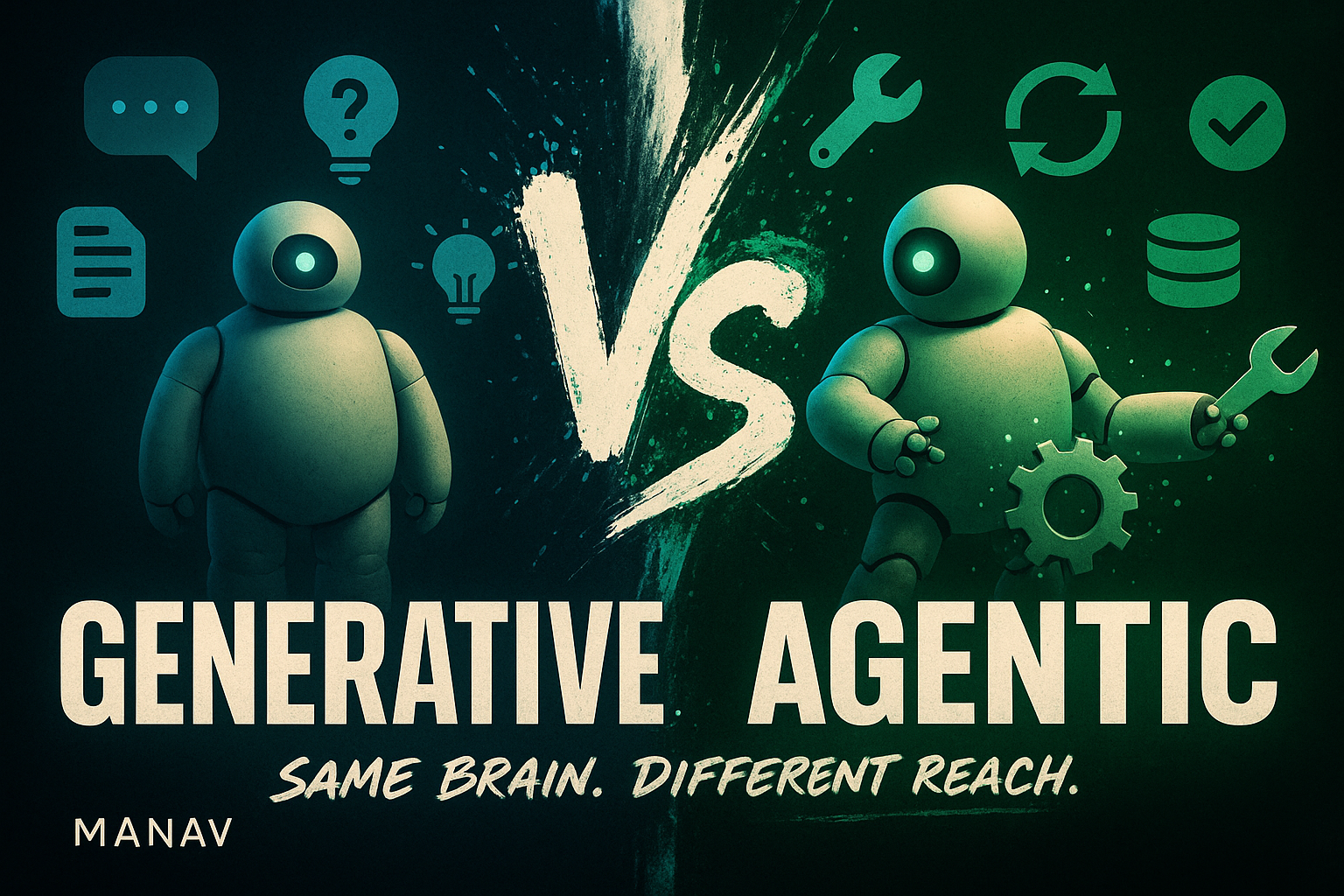
Generative AI produces content in response to a prompt. Agentic AI pursues a goal by planning and taking actions, usually with a generative model as its reasoning engine.
Everything else in this article is a longer, more useful version of that single sentence.
What generative AI actually is

Generative AI creates net-new outputs — text, images, code, audio, video — from patterns learned during training. You give it a prompt, it gives you a response, and the loop ends there.
The strengths: fast, cheap, good at drafting, good at summarizing, good at answering questions when the context fits in one turn.
The limits: no memory across sessions unless you plumb it in, no ability to take action in the outside world, no way to check its own work, no plan when a task takes 12 steps instead of 1.
What agentic AI actually is

Agentic AI is goal-oriented software. Give it an objective ("close the books for August", "draft and send a follow-up to every lead that opened our last email", "reconcile these invoices with the PO log"), and it will:
- Plan — break the goal into steps.
- Use tools — call APIs, search files, query databases, send email, update a CRM.
- Remember — carry context across the whole run and often across runs.
- Self-correct — notice when a step failed and try a different approach.
- Report — hand back a summary of what was done and what needs human attention.
Agentic AI is almost always built on top of generative AI. As Red Hat put it, "agentic AI is usually built on top of generative AI, using a generative model as its reasoning engine and adding planning, memory, tool use, and execution to turn reasoning into action." The generative model is the brain; the agentic layer is the plan, the tools, the memory, and the safety wrappers.
Side-by-side: 7 practical differences
Neither is "better". A blog post draft is a generative AI job. Closing your monthly books is an agentic AI job.
When to use which — a decision rule
Use generative AI when:
- The task is one turn — draft, summarize, translate, explain.
- You want the output to review and edit yourself.
- There is no external system the AI needs to touch.
Use agentic AI when:
- The task spans multiple steps or systems.
- You want the AI to do the work, not just recommend it.
- The same task runs repeatedly — automation compounds.
- You need memory of what happened last time.
A rough rule: if you would give the task to a junior employee with a morning to spend on it, that is agentic AI territory.
Why 2026 is when agentic AI actually shipped

The idea of agentic AI has been around since the early GPT-4 era. What changed in 2026 is that it became operationally viable at scale.
- Multi-step reasoning quality crossed the threshold where a 10-step plan completes without a human intervening on every step.
- Tool-use protocols (like MCP) matured, so agents can safely call external systems without a mountain of glue code.
- Enterprise governance caught up — audit trails, guardrails, cost caps.
- Prices dropped enough that running an agent 24/7 became cheap.
The result: what was a demo in 2024 is a shipping product in 2026. As Thomson Reuters describes the core difference, "agentic AI makes decisions and takes action to keep a process going, while GenAI reacts to input and creates output." That distinction — reactive vs goal-oriented — is what turned agentic AI from a research idea into an enterprise line item this year.
How MANAV combines both
On MANAV, every agent uses generative AI as its reasoning engine and layers agentic behavior on top — planning, tool access, memory, guardrails, and hand-offs between teammates.
That means you get the best of both: the creativity of a language model and the reliability of software that finishes the job.
Curious what an agentic team looks like in practice? Read our guide on building your first AI workforce.
Agentic AI vs generative AI — FAQ
Is agentic AI the same as an AI agent? Effectively yes. "Agentic AI" is the category; "AI agent" is one instance of it.
Does agentic AI replace generative AI? No — it uses it. Every agentic system needs a generative model at its core.
Is agentic AI safe? It is exactly as safe as the guardrails you put around it. Never give an agent a tool you would not give an intern on day one.
Do I need to write code to use agentic AI? Not with MANAV. The platform ships pre-built agents you can activate and configure in the browser.
You may also like
AI Audit Trail: How to Audit Your AI Agents (2026 Compliance Guide)
An AI audit trail is the tamper-evident record of what your AI agent did, when, and why. With the EU AI Act's enforcement window opening August 2, 2026, and 88% of enterprises reporting AI agent security incidents in the last year, an audit-ready agent is no longer optional. Here's what the audit trail actually needs to capture, how to build one that survives an auditor's questions, and why retrofitted audit trails always cost more than the ones you build on day one.
AI Red Lines: What the UN Actually Asked For (and What Your Team Should Do)
On September 7, 2026, UN rights chief Volker Türk asked the world to agree on "AI red lines" — actions AI should never be permitted to take without a human. The signal in that statement is not "slow AI down." It is "decide which actions require a human, then enforce it." Here is what red lines mean, why they matter, and how your team draws them this week.
AI Agent Evaluation: The Framework Every Team Should Adopt in 2026
An AI agent evaluation framework is how you know your agent is any good — before you ship it, and while it runs in production. This guide covers the three-level eval stack (unit tests, LLM-as-judge, online evals), the metrics that actually matter for agents (versus one-shot LLMs), and how to design rubrics that stabilize at 85%+ human agreement in three iterations.